
Research
AI Visibility: We Tested 179 Johannesburg Businesses on 4 AI Assistants
We tested the AI visibility of 179 Johannesburg small businesses on ChatGPT, Gemini, Perplexity and Google AI Mode. Almost three in four were never named.

AI visibility is the new form of an old question: when a customer asks for a plumber, a vet or an attorney, does your business come up? A growing share of those questions now goes to ChatGPT and to Google's AI instead of a page of blue links. So on 3 October 2026 we put the same request to four AI assistants, three times each, for small businesses across Johannesburg. Most were never mentioned once. The ones that were had two things in common, and neither is what website owners usually worry about.
AI visibility in Johannesburg: almost three in four businesses were never named
Of the 176 Johannesburg small businesses in the test, 128 were not named by any of four AI assistants in any of three rounds, which is 73%. Each business had 12 chances: four assistants, three rounds each.
Only 48 were named at least once. Of those, 24 were named by one assistant, 10 by two and 12 by three. Just 2 were named by all four.
These aren't obscure firms. Every one came from the first Google Maps listings for its trade, so they are the businesses Google already puts in front of people.
Google's AI answers on an ordinary search tell the same story. An AI Overview is the AI-written summary Google shows above some search results. Only 35 of the 179 websites in the study had been used as a source by any AI Overview on record for South Africa.
Put the two tests together and 112 of the 176 businesses had nothing at all. No assistant named them, and no Google AI answer cited them.
What is AI visibility?
AI visibility is how often AI assistants such as ChatGPT, Gemini, Perplexity and Google's AI answers name your business, or use your website as a source, when someone asks a question you could answer. It has two parts. Being named means the assistant recommends you. Being cited means the assistant links to your website as the place it got its facts.
Why should a local business care? Because customers have started asking. In BrightLocal's survey of 1 002 adults in the United States, published in February 2026, 45% had used ChatGPT or another AI tool for local recommendations, up from 6% a year earlier. That is an American figure. We haven't found a South African one.
Google is moving the same way. Its chief executive told the company's developer conference in May 2026 that AI Overviews had passed 2.5 billion monthly users.
How we tested 179 businesses
We asked four AI assistants the question a customer would ask, once for every trade and area in the study, and repeated it three times. Here is exactly what that means, so you can judge the numbers for yourself.
- The businesses. The 179 websites from our website loading speed study: the first Google Maps listings for 15 trades across Johannesburg, Sandton, Randburg, Roodepoort, Midrand and Soweto, with franchises, chains and directories left out. Three had no clear trade to ask about, so the recommendation test covers 176.
- The question. "I need a plumber in Randburg, Johannesburg, South Africa. Which businesses would you recommend? Name them." One question for each of 88 trade and area pairs.
- The assistants. ChatGPT (GPT-5.5), Gemini (3.8 Flash), Perplexity (Sonar Pro) and Google AI Mode, which is Google's chat-style search. All four searched the live web. Each got every question three times: 1 056 answers in all.
- What counted as named. The business's name or web address appearing in the answer. Near matches were checked by hand.
- The other checks. We asked ChatGPT and Perplexity about each business by name, looked up each website in a record of Google's AI Overviews, and ran 83 local Google searches on a phone.
That said, the test has limits. We reached the assistants through DataForSEO, a data provider, and not through the apps on a phone. The apps know where you are and what you asked before, so your own answer may differ. Everything was run on one day. The list is the first results Google returned, not a random sample of every business in the city.
We don't name any business here. The point is the pattern.
Want your own result first? Our free Google visibility check takes about a minute and reports whether Google's AI answers cite your website and whether you show in the map results.
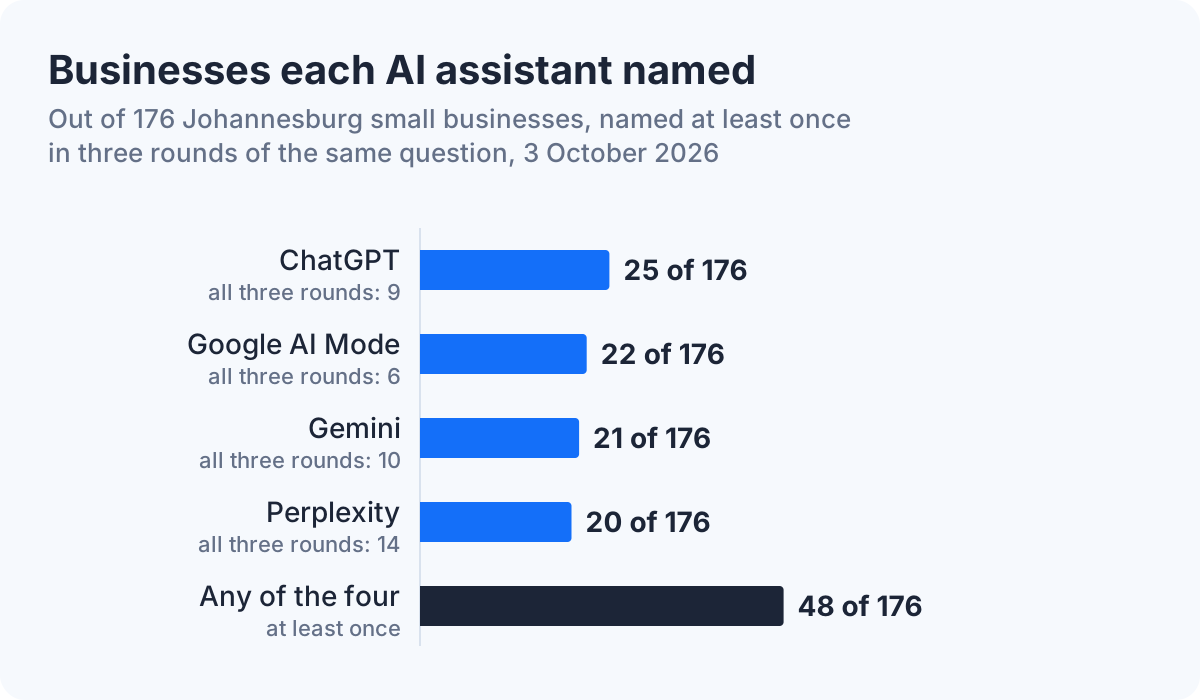
Which AI assistant named the most businesses?
ChatGPT named the most businesses, 25 of the 176, but no assistant named more than one in seven. The four were closer to each other than we expected.
| AI assistant | Named at least once in three rounds | Named in all three rounds | Named in a single round |
|---|---|---|---|
| ChatGPT | 25 | 9 | 16 to 19 |
| Google AI Mode | 22 | 6 | 11 to 18 |
| Gemini | 21 | 10 | 15 to 17 |
| Perplexity | 20 | 14 | 16 to 19 |
Here's the thing. The same question doesn't get the same answer twice.
ChatGPT named 19 businesses in the first round, and only 9 of those made all three rounds. Google AI Mode was the least settled: 18 named in round one, 6 in all three. Perplexity changed least, with 14 of its first 16 named every time.
So one test proves little. If an assistant names you once, ask it again.
Google reviews separated the named from the unnamed
The businesses the assistants named had a median of 34 Google reviews, and the businesses they never named had a median of 5.5. No other measure we took split the two groups as cleanly.
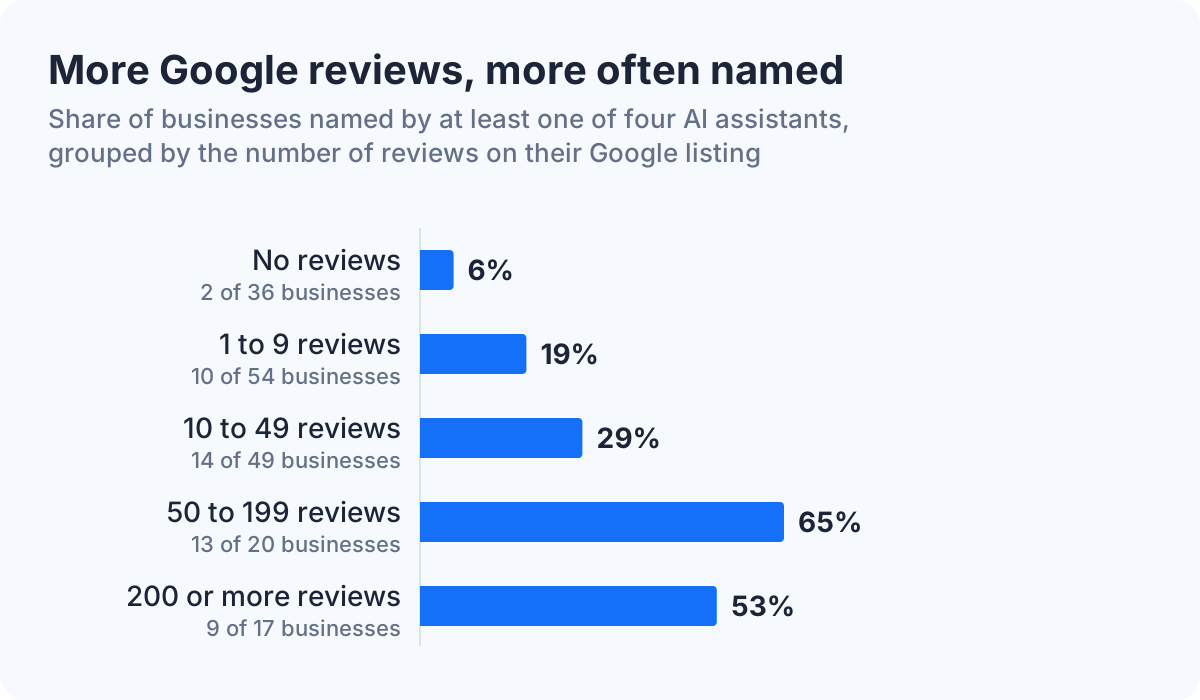
Fifty reviews looked like the line. Of the 37 businesses with 50 or more, 22 were named. Of the 139 with fewer, 26 were. Businesses with no reviews at all barely featured: 2 of 36.
The number of reviews mattered more than the stars. The median rating was 4.8 for the named group and 4.7 for the rest.
Google's AI Mode shows where this comes from. In 252 of its 264 answers it printed star ratings and review counts next to the businesses it suggested, and 199 answers linked straight to Google listings. It reads Google Business Profiles, the free listings behind every business on Google Maps. Google's own help page on local results says "More reviews and positive ratings can help your business's local ranking".
Owning the listing counted too. Of the 143 businesses that had claimed their Google listing, 46 were named. Of the 33 that hadn't, 2 were.
Treat all of this as a pattern, not proof of cause. A busy, well-known business collects reviews and gets written about, and either could be what the assistants pick up.
Is SEO dead now that customers ask AI?
No. In our test the businesses that already ranked on Google were the ones the AI assistants named.
We counted how many Google searches each website shows up for in South Africa, using DataForSEO's estimates. The named businesses ranked for a median of 44 searches. The unnamed ranked for a median of 1.
| Google searches the website ranks for | Businesses | Named by an AI assistant |
|---|---|---|
| 0 to 4 | 86 | 10 (12%) |
| 5 to 19 | 31 | 9 (29%) |
| 20 to 99 | 39 | 18 (46%) |
| 100 or more | 20 | 11 (55%) |
Google says as much. Its guidance for site owners states that "There are no additional requirements to appear in AI Overviews or AI Mode, nor other special optimizations necessary", and that a page must be "indexed and eligible to be shown in Google Search with a snippet".
So what gets sold as AI SEO is mostly the SEO you'd do anyway: pages that answer what customers ask, on a site Google can read. That is the idea behind the articles we write for clients.
Reviews and rankings together did the most. Of the 24 businesses with 50 or more reviews and 20 or more ranking searches, 15 were named. Of the 104 with neither, 12 were.
Where AI assistants get their recommendations
ChatGPT and Perplexity leaned on business directories, and Google's AI leaned on Google's own listings.
ChatGPT cited at least one directory or listing site in 223 of its 264 answers, which is 84%. Perplexity did so in 258 of 264. The names will be familiar to anyone who has looked for a tradesman online:
- ChatGPT's most cited sources: Snupit, Bestinhood, Procompare, TopReviews and Reddit.
- Perplexity's most cited sources: LinkedIn, GoAfricaOnline, Snupit, Procompare and Bark.
- Google AI Mode: Google listings, in three out of four answers.
In practice, though, this means a business can be recommended on the strength of a directory page alone. It also means a wrong phone number on an old directory page can travel a long way.
See whether Google's AI cites your website
Type in your address. Add what you do and where, and we also check Google's map results for you. Free, no email needed.
Check my Google visibilityWhat made no difference: speed and WordPress
How fast a website loads, and what it is built with, made no measurable difference to whether an AI assistant named the business. We sell fast websites, so we'd have liked a different result.
Of the 68 WordPress sites that loaded, 20 were named. Of the 61 sites we couldn't match to any site builder, 20 were named too. Speed showed no pattern either: 3 of the 19 fast sites were named, and 23 of the 60 that took over 10 seconds.
Speed still matters once a customer taps through. It just isn't what gets you named.
Two technical things did line up with being named.
A website that loads. Of the 22 businesses whose website didn't load in our speed test, 1 was named. Of the 154 whose website did load, 47 were.
Structured data. Structured data is a set of labels in a page's code that tells Google and AI assistants what the business is, where it is and what it offers. Of the 74 sites that loaded and had it, 30 were named. Of the 80 without, 17 were.
AI visibility by trade
Locksmiths were named most often and law firms not at all. The table lists the 11 trades with at least eight businesses in the test.
| Trade | Businesses tested | Named by at least one assistant |
|---|---|---|
| Locksmiths | 12 | 8 |
| Vets | 10 | 5 |
| Car repair workshops | 10 | 4 |
| Pest control | 10 | 4 |
| Architects | 15 | 4 |
| Physiotherapists | 12 | 3 |
| Optometrists | 8 | 2 |
| Accountants | 12 | 2 |
| Dentists | 9 | 1 |
| Guest houses | 12 | 1 |
| Law firms | 15 | 0 |
Read the table as a rough guide. Eight to 15 businesses is a small group.
For law firms the assistants named other firms every time. Across 72 answers about attorneys, none of the 15 small practices came up.
Does AI know your business when you ask by name?
Mostly, yes. Asked about each business by name, ChatGPT linked to the business's own website for 137 of the 179, and Perplexity for 106.
ChatGPT also got the phone number right more often. It gave the number shown on the Google listing for 134 of 176 businesses, against 84 for Perplexity. ChatGPT said it couldn't find the business 11 times, and Perplexity 18 times.
Being known is not the same as being recommended. Three in four of these businesses could be found by name, and three in four were never suggested to a customer who didn't already know them.
How can I check the AI visibility of my website?
You can check the AI visibility of your website in three ways, and the first takes about a minute.
- Run the free check. Our Google visibility check, linked below, reports how many Google AI answers on record used your website as a source, and whether you show in the map results for your trade and area.
- Ask the assistants yourself. Open ChatGPT and Google's AI Mode in a private window and type what a customer would: "I need a dentist in Sandton. Which would you recommend?" Ask three times, because the answer changes.
- Search on your phone. Type your trade and your area into Google. Of the 83 local searches we ran in Johannesburg, 73 showed map results and only 10 showed an AI answer. For a local business, the map is still where most customers look.
How to get AI visibility for a local business
A local business gets AI visibility the way the named businesses in our test had it: many Google reviews, pages that rank on Google, and listings on the directories the assistants read. In order of effort:
- Claim and complete your Google Business Profile. Google's AI Mode builds its answers from these listings. Check the category, the address, the hours and the website link.
- Ask every happy customer for a Google review. Fifty was the line in our data. Most of the unnamed businesses had fewer than ten.
- Get listed where the assistants look. Snupit and Procompare came up most in our test. Make sure your name, number and website are right on each.
- Publish pages that answer what customers ask. A site that ranks for 20 or more searches was named nearly half the time.
- Keep the door open. A website that doesn't load can't be read. OpenAI's own documentation says, "we recommend allowing OAI-SearchBot in your site's robots.txt file", which is the reader ChatGPT uses for search. Only 2 of the working sites in our study blocked AI readers.
Nobody can promise that an AI assistant will name your business. We can't either. What the test shows is which businesses the assistants reached for, and every one of those five steps is in your hands.
Find out where your business stands
The check takes about a minute and shows your result on the page, next to the figures from this study.
Run my free checkRather have it done for you? Ask for the free website audit and we check Google, the AI assistants and your speed, then call to explain it.
Change your website by sending an email
We rebuild your WordPress site to load fast, then you email changes and approve every one before it goes live. R1 500 a month for the first 6 months, then R750 a month.